
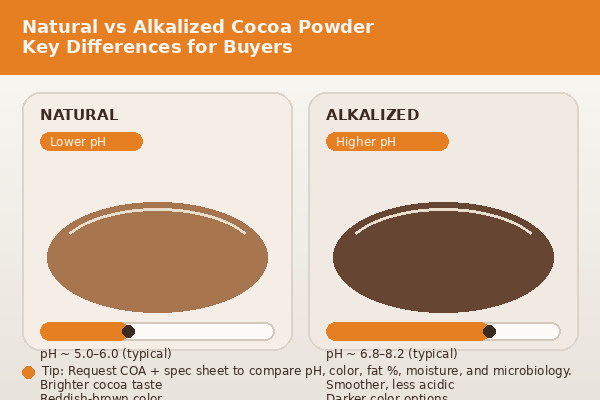
If you are sourcing cocoa powder for manufacturing, distribution, or private label, the most common question is simple: Should I buy natural cocoa powder or alkalized (Dutch-processed) cocoa powder? The right choice affects not only taste and color, but also how your product behaves during mixing, baking, and storage. This guide explains the practical differences buyers should know—so you can select the right cocoa powder grade, avoid formulation surprises, and compare supplier offers with confidence.
1) How They Are Made (The Core Difference)
Natural cocoa powder is produced by pressing cocoa liquor to remove cocoa butter, then milling the remaining cocoa cake into powder. It keeps more of cocoa’s natural acidity.
Alkalized cocoa powder goes through an additional step: cocoa nibs, cocoa liquor, or cocoa cake is treated with alkalizing agents (often potassium carbonate) to reduce acidity and modify color and flavor. Because the alkalization step can be applied at different stages and intensities, alkalized cocoa powders vary widely—from medium brown to very dark shades.
Buyer takeaway: “Alkalized” is a process, not a single specification. Always confirm the pH and color range.
2) pH and Acidity
- Natural cocoa powder: typically more acidic, often around pH ~ 5.0–6.0
- Alkalized cocoa powder: less acidic / more neutral, often around pH ~ 6.8–8.2
Why this matters: pH influences flavor perception (sharp vs smooth), color development, and how cocoa interacts with leavening agents in bakery products.
Buyer takeaway: If your formula uses baking soda and depends on acidity for lift, natural cocoa may be the better match—unless your R&D team adjusts the leavening system.
3) Flavor Profile
- Natural: more “bright,” sometimes sharper cocoa notes; can feel more intense in certain applications
- Alkalized: smoother, less bitter, less acidic; often perceived as more “rounded” or “chocolatey” in beverages and dairy-based products
Flavor is subjective and depends on origin and processing, but in general alkalization reduces acidity and can soften certain astringent notes.
Buyer takeaway: If your product is sensitive to acidity (e.g., dairy drinks), alkalized cocoa is frequently easier to work with.
4) Color and Visual Consistency
Color is one of the most visible differences:
- Natural: typically lighter and more reddish-brown
- Alkalized: wider spectrum—medium brown to very dark brown/black (depending on alkalization level)
Color affects consumer expectations (especially in chocolate beverages, biscuits, and ice cream). Buyers often select alkalized cocoa when they want a darker, more uniform shade.
Buyer takeaway: Ask suppliers for color specs (some use visual standards, others provide Lab* values). Also ask how tightly they control batch-to-batch color.
5) Dispersion, Solubility, and Processing Behavior
Cocoa powder is not “soluble” like sugar, but it should disperse well in liquid systems. Alkalized cocoa often disperses more easily in many beverage applications due to changes in surface properties and reduced acidity—though results vary by process and fineness.
For buyers, the practical questions are:
- Does it disperse smoothly without clumping?
- Does it settle quickly in a beverage?
- Does it create the mouthfeel you want?
Buyer takeaway: For beverages, request a sample and run a simple dispersion test under your real mixing conditions.
6) Best Applications (Quick Decision Guide)
Natural cocoa powder is commonly chosen for:
- Cakes, brownies, cookies (especially formulas designed for natural cocoa)
- Products where a brighter cocoa note is desired
- Bakery systems using baking soda (where acidity supports leavening)
Alkalized cocoa powder is commonly chosen for:
- Chocolate drinks, dairy beverages, and instant mixes (often smoother and darker)
- Ice cream, fillings, sauces, coatings
- Products where dark color and mild flavor are priorities
Buyer takeaway: Match cocoa type to your application first, then fine-tune by fat %, color, and particle size.
7) What Buyers Should Request From Suppliers
To compare quotes accurately and avoid mismatched deliveries, request:
- Product Specification Sheet
- COA (Certificate of Analysis) for a recent batch
- Key parameters: pH, fat %, moisture %, color spec, fineness/particle size
- Microbiology (TPC, yeast & mold, E. coli/coliform, Salmonella absent)
- Heavy metals testing if required by your destination market
- Packaging details (bag size, palletizing, container loading plan if needed)
Buyer takeaway: The words “natural” and “alkalized” are not enough. The COA is what makes offers comparable.
8) Common Purchasing Mistakes to Avoid
- Assuming all alkalized cocoa is the same (it isn’t—pH and color vary widely).
- Ignoring leavening interactions in bakery formulas.
- Comparing prices without matching specs (fat %, pH, and color can change cost and performance).
- Skipping sample trials for beverages and dairy systems.
Final Recommendation
For buyers, the best choice is the cocoa powder that meets your application performance, spec requirements, and supply reliability. Natural cocoa powder often fits classic bakery systems and brighter flavor profiles. Alkalized cocoa powder frequently wins when you need smoother taste, darker color options, and easier dispersion in many beverage and dairy applications.
If you want, tell me your end product (e.g., cookies, chocolate drink, ice cream) + target color + fat % range, and I’ll recommend which cocoa type to shortlist and what exact specs to request from suppliers.