
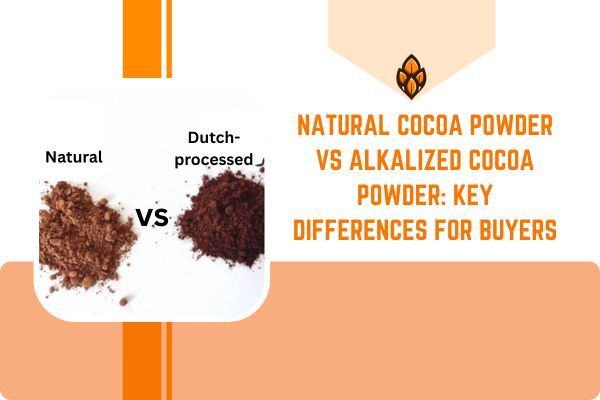
If you buy cocoa powder for food manufacturing, distribution, or private label, the choice between natural cocoa powder and alkalized (Dutch-processed) cocoa powder can directly impact your product’s taste, color, and production stability. While both come from pressed cocoa solids, the processing difference changes key characteristics that matter to buyers: pH, flavor perception, color intensity, and how the cocoa behaves in your formula.
This guide explains the real-world differences and gives a buyer-focused checklist so you can compare supplier offers accurately.
1) The Processing Difference (What Changes Everything)
Natural cocoa powder is produced by pressing cocoa liquor to remove cocoa butter, then milling the remaining cocoa cake into powder. It retains more of cocoa’s natural acidity.
Alkalized cocoa powder goes through an additional step where cocoa material is treated with alkalizing agents (commonly food-grade alkalis) to reduce acidity and alter color and flavor. Alkalization can be light or strong, so alkalized cocoa ranges from medium brown to very dark shades.
Buyer takeaway: “Alkalized” is not one standard product—always confirm the actual pH and color target.
2) pH and Acidity (A Key Buyer Spec)
In general:
- Natural cocoa powder: more acidic, often around pH ~ 5.0–6.0
- Alkalized cocoa powder: less acidic/more neutral, often around pH ~ 6.8–8.2
Why this matters:
- pH affects flavor brightness vs smoothness
- pH influences baking chemistry, especially with leavening agents
- pH can impact dairy stability and overall taste balance in beverages
Buyer takeaway: If your product is sensitive to acidity (many dairy or beverage systems are), alkalized cocoa often reduces formulation risk.
3) Flavor Profile (Bright vs Smooth)
Typical differences:
- Natural: brighter cocoa note, sometimes sharper or more “intense”
- Alkalized: smoother, less acidic, often perceived as more rounded and mild
However, flavor is influenced by many variables (bean origin, roast profile, fat %, particle size). That’s why samples matter.
Buyer takeaway: Don’t judge only by raw cocoa taste—test in your final recipe.
4) Color Outcomes (Critical for Consumer Expectations)
Color is one of the most visible differences:
- Natural cocoa: usually lighter and more reddish-brown
- Alkalized cocoa: broader color range and typically darker, depending on alkalization level
For products like cookies, cakes, chocolate drinks, and ice cream, buyers often select cocoa based on the exact shade they want after processing.
Buyer takeaway: Ask for a defined color spec (visual reference or Lab* values if available) and confirm how tightly the supplier controls batch-to-batch color.
5) Dispersion and Processing Behavior
Cocoa powder does not “dissolve” like sugar, but it should disperse well. Alkalized cocoa often disperses more easily in many beverage applications, but performance depends on:
- particle size/fineness
- moisture
- processing method and alkalization intensity
Buyer takeaway: Run a quick dispersion test (your water/milk ratio, your temperature, your mixing method) before approving a supplier.
6) Best Use Cases (Practical Selection Guide)
Natural cocoa powder is commonly used for:
- bakery formulas designed around natural cocoa
- products needing a brighter cocoa note
- systems where acidity is part of the intended profile
Alkalized cocoa powder is commonly used for:
- chocolate drinks and instant mixes
- dairy applications (ice cream, flavored milk)
- cookies/cakes where darker color is desired
- formulations aiming for smoother taste with lower acidity
Buyer takeaway: Choose cocoa type based on application performance, then refine using pH, fat %, and color.
7) What Buyers Should Request From Suppliers
To compare suppliers correctly, request:
- Product Specification Sheet
- COA (Certificate of Analysis) for a recent batch
- Key parameters: pH, fat %, moisture %, color, fineness
- Microbiology limits (TPC, yeast & mold, coliform/E. coli; Salmonella absent is commonly expected)
- Heavy metals testing if required by your destination market
- Packaging details and lead time
Buyer takeaway: If two suppliers quote different fat % or different pH ranges, their prices are not directly comparable.
8) Common Buying Mistakes to Avoid
- Comparing prices without matching specs (fat %, pH, and color drive performance and cost).
- Assuming all alkalized cocoa is the same (it isn’t; color and pH vary widely).
- Skipping pilot tests (especially for beverages and dairy).
- Ignoring leavening chemistry when switching natural ↔ alkalized in bakery formulas.
Conclusion
Natural and alkalized cocoa powders serve different goals. Natural cocoa often supports brighter flavor profiles and traditional bakery systems, while alkalized cocoa is frequently chosen for smoother taste, darker color options, and easier handling in many beverage and dairy applications. For buyers, the smartest decision comes from matching specs, verifying with COA, and testing samples in real conditions.