
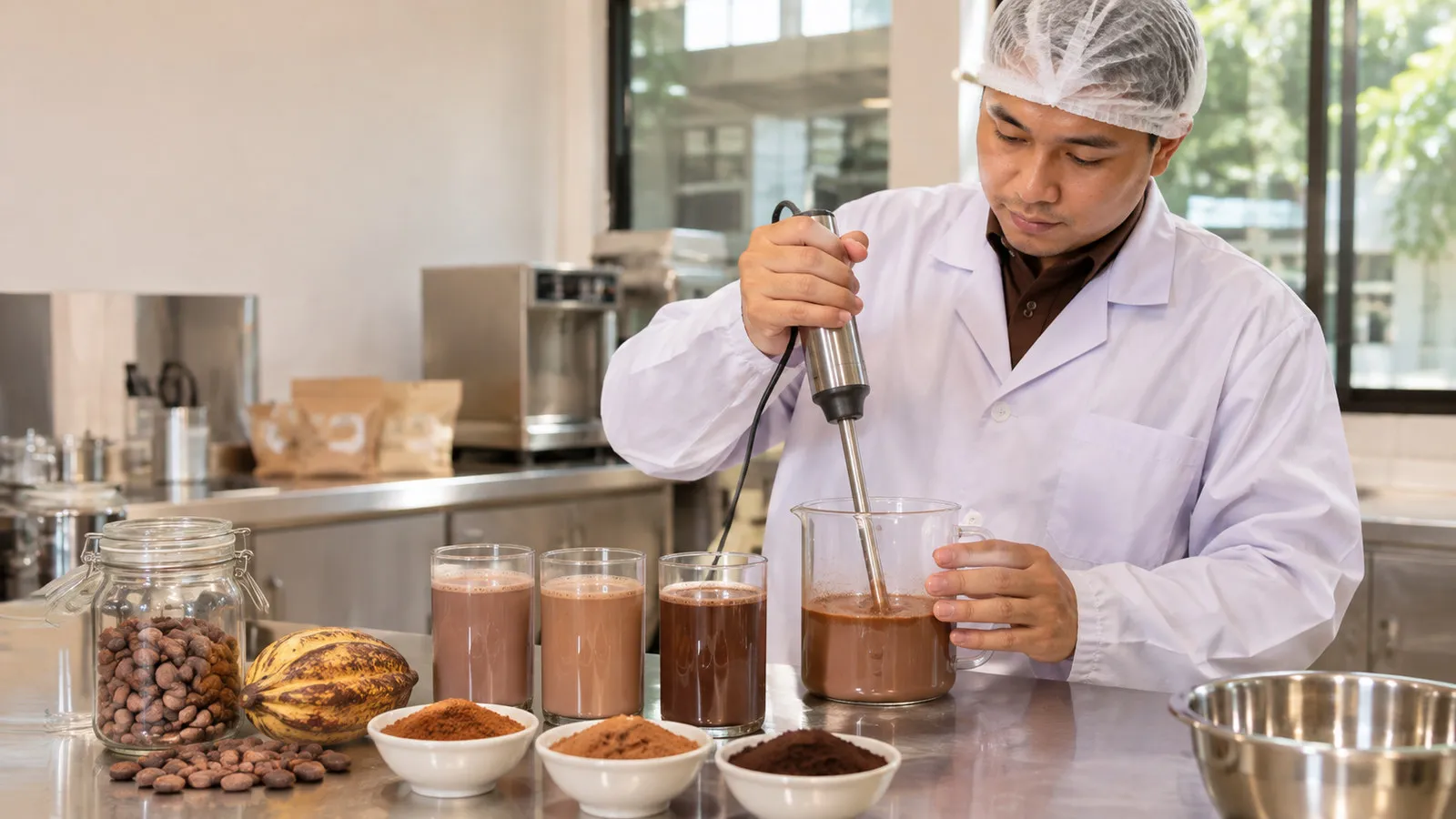
Cocoa powder is widely used in chocolate drinks, dairy beverages, instant beverage premixes, and other flavored drink applications.
For beverage manufacturers, however, achieving the desired chocolate flavor is only one part of successful product development.
Dispersion, sedimentation, color, mouthfeel, and processing compatibility can significantly influence the finished product.
Understanding these characteristics helps manufacturers make better decisions when evaluating cocoa ingredients.
1. Choosing the Right Cocoa Powder Profile
Cocoa powders are available in different color and processing profiles, including natural and alkalized varieties.
Natural cocoa typically offers a more acidic character, while alkalized cocoa has been processed to modify acidity, flavor, and color.
Alkalized cocoa may be preferred for particular chocolate beverages because of its darker appearance and smoother perceived flavor profile.
However, the best choice depends on the complete formulation, processing method, and desired consumer experience.
Manufacturers should evaluate multiple samples rather than selecting a grade based exclusively on color.
2. Dispersion Is Different from Solubility
One of the most common misunderstandings in beverage manufacturing is the assumption that cocoa powder dissolves completely in water.
In reality, cocoa powder contains insoluble particles.
A well-formulated cocoa beverage therefore requires effective particle wetting, dispersion, and suspension rather than relying on complete dissolution.
Poor dispersion may cause powder to float, form lumps, or accumulate at the bottom of the container.
Particle characteristics, mixing intensity, temperature, fat content, and other ingredients can all affect beverage performance.
3. Understanding Sedimentation
Sedimentation occurs when suspended particles gradually settle under gravity.
This can become especially noticeable in ready-to-drink beverages or products intended to remain stable during extended storage.
Manufacturers may need to consider the influence of particle size, product viscosity, stabilizer systems, and homogenization conditions.
Importantly, a powder that disperses successfully during initial mixing may still produce sediment over time.
For this reason, beverage testing should include observations immediately after production and throughout the intended shelf-life period.
4. Flavor and Color Evaluation
A cocoa powder that performs well in water may produce a different sensory profile when incorporated into milk, plant-based beverages, or high-sugar premixes.
Fat, sweetness, protein, and other formulation components can modify perceived cocoa intensity.
Manufacturers should compare samples at the same cocoa dosage and under standardized preparation conditions.
Useful evaluation criteria include:
- Chocolate flavor intensity
- Bitterness and acidity
- Color appearance
- Mouthfeel
- Aroma after heating
- Sedimentation and surface separation
A successful ingredient is one that performs consistently within the actual finished-product formulation.
5. Conducting a Practical Beverage Trial
A structured laboratory trial can reduce uncertainty before commercial production.
Step 1 — Establish a reference formulation
Use a standard recipe with clearly documented ingredient proportions.
Step 2 — Prepare samples consistently
Keep mixing time, temperature, equipment, and addition sequence consistent.
Step 3 — Compare cocoa grades
Evaluate natural, brown alkalized, or darker alkalized samples against the target sensory profile.
Step 4 — Assess physical performance
Observe wetting, lump formation, sedimentation, and visual appearance.
Step 5 — Conduct stability testing
Evaluate the product under the storage conditions relevant to its intended distribution and shelf life.
6. Selecting a Supplier for Long-Term Production
After identifying a suitable formulation, ingredient consistency becomes especially important.
A change in pH, particle characteristics, flavor, or color can affect finished-product quality.
Procurement and R&D teams should agree on technical acceptance criteria before approving commercial orders.
Batch specifications and a clearly defined sample approval process help support repeatable production.
Conclusion
The right cocoa powder for beverage manufacturing must satisfy several requirements simultaneously.
Flavor, color, dispersion, sedimentation, and compatibility with the finished formulation should all be considered.
Explore Cocoa Ingredient Solutions with Zencocoa
PT Brilian Zenco Agroindo supports industrial buyers in evaluating cocoa ingredient profiles for different applications.
Contact our team to discuss your product requirements, technical specifications, and sample evaluation.
Explore Our Product Range: https://zencocoa.com/