
For international cocoa ingredient buyers, packaging is not simply a matter of appearance or convenience.
The packaging system plays an important role in protecting product quality, supporting traceability, facilitating handling, and reducing the possibility of damage during transportation.
Cocoa ingredients may travel thousands of kilometers before reaching a customer's production facility.
Selecting the right packaging and loading configuration is therefore an essential part of export planning.
1. Why Packaging Matters for Cocoa Ingredients
Dry cocoa ingredients should be protected from excessive moisture, contamination, physical damage, and exposure to unsuitable environmental conditions.
Cocoa products can also absorb surrounding odors, making proper storage and protection important throughout the supply chain.
A damaged bag may create product loss, handling difficulties, and quality concerns.
Effective packaging should account for both product protection and practical distribution requirements.
2. Understanding 25 kg Industrial Packaging
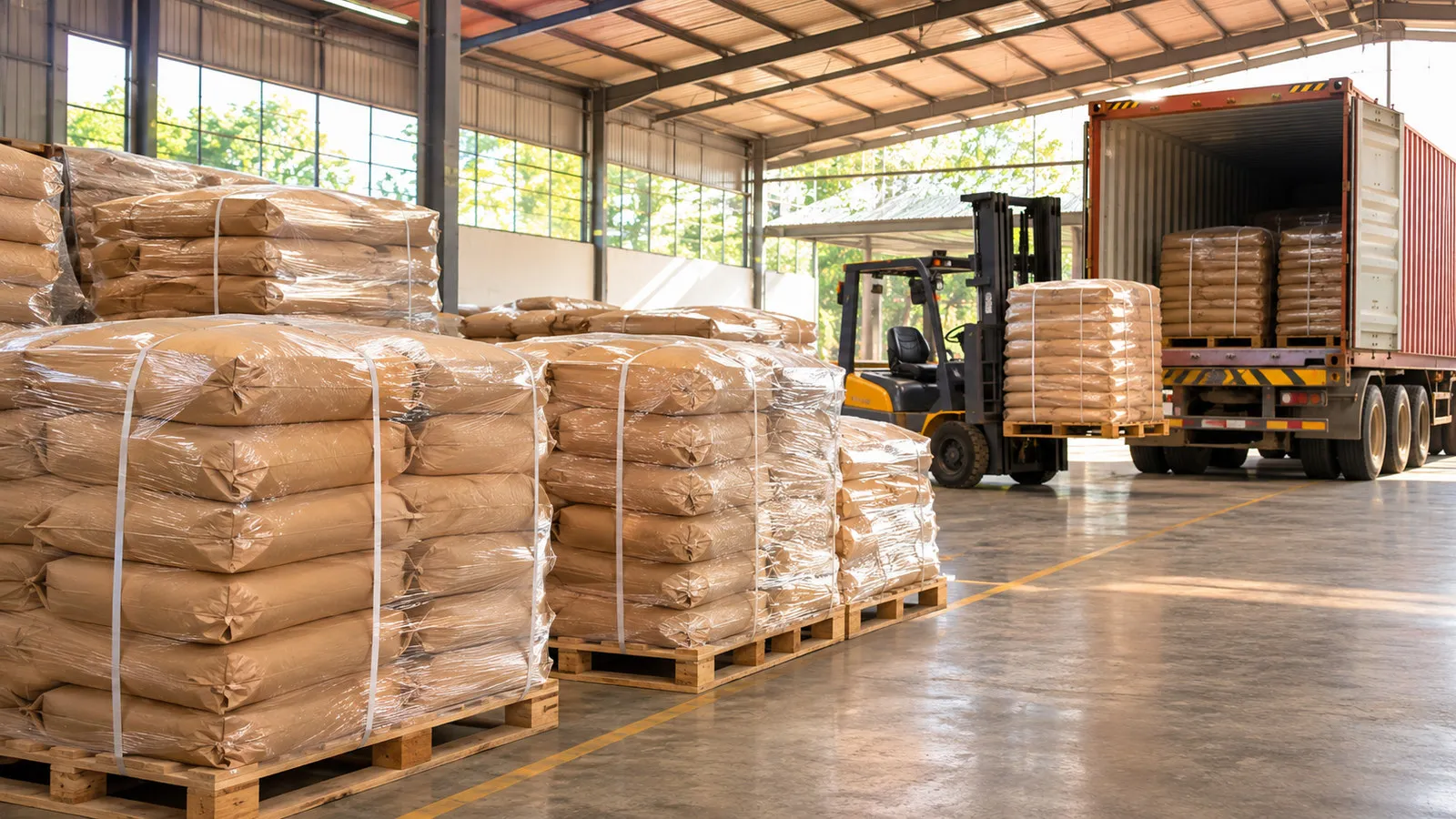
One commonly used format for bulk cocoa ingredients is the 25 kg multiwall kraft paper bag.
This format provides a manageable unit for commercial handling, warehouse storage, and containerized transportation.
An appropriate inner liner can provide additional protection against moisture and contamination.
The final packaging specification should consider:
- Bag material and construction
- Inner liner type
- Closure integrity
- Net weight
- Batch identification
- Labeling requirements
- Storage and transport conditions
Packaging design should be validated against the product's actual characteristics and the intended distribution environment.
3. Palletized Versus Floor-Loaded Shipments
International buyers may choose between palletized loading and floor loading.
Palletized Loading
Palletized shipments can support faster forklift handling and more efficient warehouse operations.
They can also simplify inventory counting and unloading.
However, palletized loads require careful consideration of stack height, load distribution, and securing methods.
Insufficient containment may allow bags to shift during transportation.
Floor Loading
Floor loading places bags directly into the container without pallets.
This configuration may improve available cargo space and reduce pallet-related costs.
However, unloading may require additional labor or specialized handling arrangements.
The choice should depend on destination handling capabilities, cargo weight, product protection, and commercial requirements.
4. Improving Pallet Stability
Pallet stability is a critical consideration for bagged industrial ingredients.
A load that appears stable inside a warehouse may encounter vibration, braking forces, and repeated handling during transport.
Important precautions include maintaining an appropriate stacking pattern, minimizing unsupported bag overhang, and selecting securing systems suitable for the load.
Depending on the shipment design, stretch wrapping, horizontal strapping, corner protectors, and additional load-restraint methods may be considered.
The pallet and securing system should be evaluated as a complete unit.
For wooden pallets, applicable phytosanitary requirements, including ISPM 15 where required, should also be considered.
5. Moisture Protection During Ocean Freight
Ocean freight can expose containerized cargo to variations in temperature and humidity.
Condensation may occur when conditions favor moisture formation on internal surfaces.
Potential precautions include dry-container inspections, suitable liners, moisture-management measures, and protection from wet or contaminated surfaces.
Desiccants may help in some situations, but they do not replace sound packaging and container preparation.
6. A Pre-Shipment Inspection Checklist
Before loading cocoa ingredients, the shipping team should verify:
- Container cleanliness, dryness, and absence of objectionable odors.
- Integrity of the floor, walls, doors, and seals.
- Packaging condition and correct bag count.
- Lot numbers and product labels.
- Pallet condition and load stability, if pallets are used.
- Weight distribution and appropriate cargo securing.
- Loading records, photographs, and final container seal details.
These checks help improve transparency and support shipment traceability.
Conclusion
Effective bulk cocoa powder packaging combines material protection, warehouse efficiency, cargo stability, and practical export logistics.
Neither palletized nor floor-loaded shipments are universally superior. The best solution depends on the product, shipping configuration, and buyer requirements.
Discuss Bulk Packaging with Zencocoa
PT Brilian Zenco Agroindo offers industrial ingredient supply with bulk packaging and export coordination.
Contact our team to discuss 25 kg packaging, shipment configuration, and your destination requirements.
Learn About Our Manufacturing & Export Capabilities: https://zencocoa.com/cocoa-powder-manufacturer-indonesia/